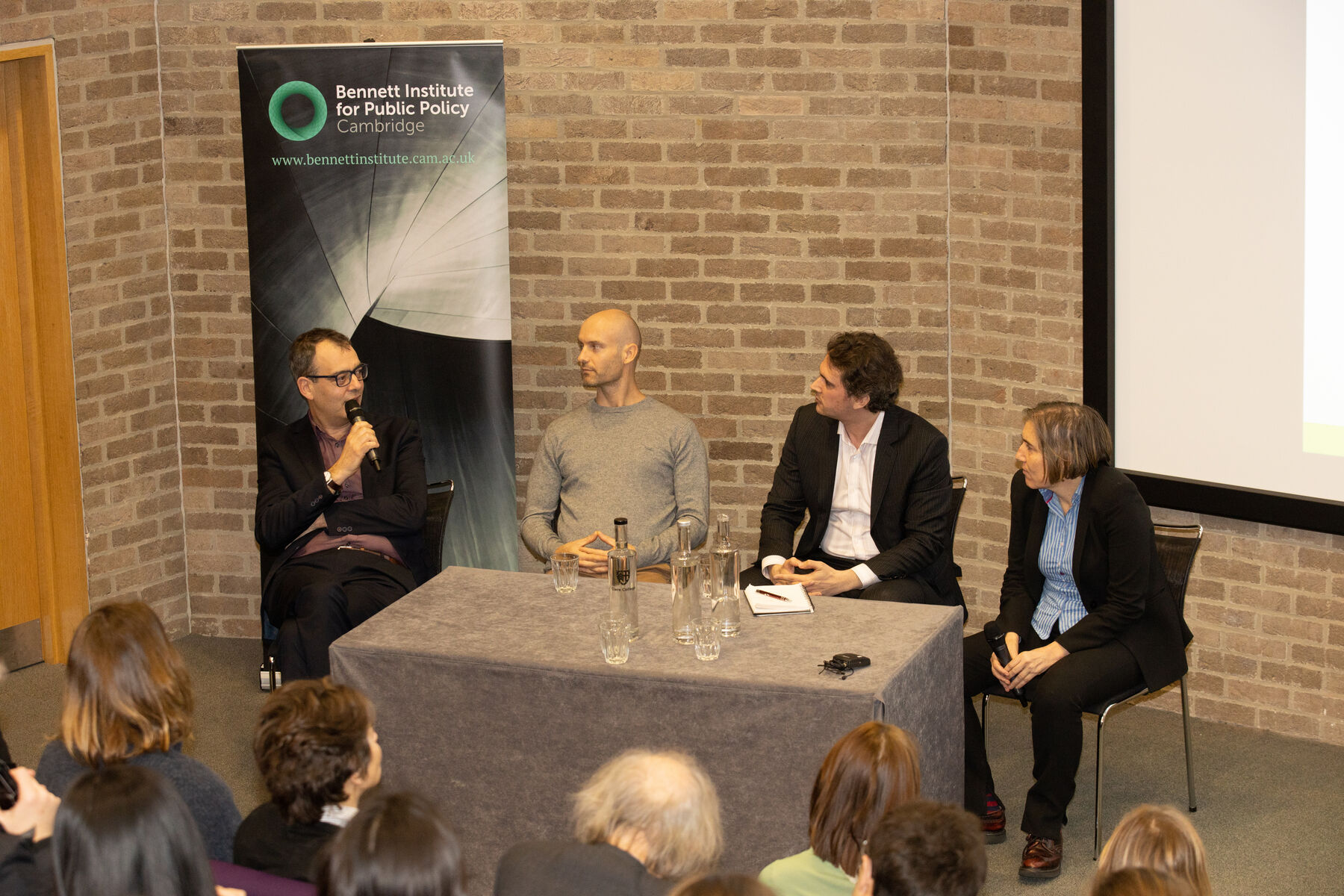
The Centre for the Future of Democracy was launched in January 2020 to explore the challenges and opportunities faced by democratic politics over the coming century. I co-founded the Centre with Professor David Runciman at the Bennett Institute for Public Policy at the University of Cambridge, and we directed it together.
The Centre's central asset is the Global Satisfaction with Democracy dataset, built with Andrew Klassen and the HUMAN Surveys project. It harmonises decades of cross-national survey data. At launch it covered more than 25 survey programmes and four million respondents in 154 countries. By 2022 it had grown to around 20 million respondents across 75 sources and 182 countries, which made it possible to track public attitudes to democracy across almost the whole world, in close to real time.
From that dataset the Centre published four flagship reports. They covered record dissatisfaction with democracy (2020), the generational "democratic disconnect" (2020), populism and the pandemic (2022) and the geopolitical divide that followed Russia's invasion of Ukraine (2022). Each was released with a University of Cambridge press release, and the coverage ran from the BBC, CNN, Reuters and the Financial Times to Der Spiegel, Folha de S.Paulo and BBC Mandarin. The Centre's research strands also covered the spatial divide in democratic politics, democracy and climate change (with Cambridge Zero and CSaP) and technology and democracy (with CRASSH and the Leverhulme Centre for the Future of Intelligence).
From 2021 the Centre carried out commissioned research on global democratic attitudes for the UK Cabinet Office, and its third report was funded by Luminate, the global philanthropic organisation. Its work was presented to the US State Department, the National Endowment for Democracy, the OECD, the Summit for Democracy and the Council of Europe's World Forum for Democracy.
After the four flagship reports, the Centre's research programme continued into peer-reviewed scholarship and policy engagement. Papers in the British Journal of Political Science, Perspectives on Politics and Democratization followed, along with new work tracking Russian public opinion through online data, briefings to the Council of Europe, and talks in Strasbourg, Montréal and Barcelona. The academic publications and chronology below set this out.